Cymatix Context
Coordinate-index engine for LLM agents. It retrieves, weighs, and compresses a corpus into a context window — without a single LLM call on the retrieval path.
- Version: this wiki documents v0.10.0, released 2026-09-29
(tag
v0.10.0, PyPI0.10.0). The prior v0.9.2 release was published 2026-09-08. v0.10.0 changes no shipped retrieval or delivery default; its new behaviour is opt-in. Changes are cited by PR number where they appear. The Tier-2 lexicon aliases the pages present as canonical (#419) follow the 0.9.1 tag and are not in the 0.9.1 wheel — on that wheel the legacy spellings are the ones that resolve. See Roadmap and Releases for the release contents. - Install:
pip install cymatix-context(Python 3.11+). Start at Getting Started. - License: Apache-2.0.
What it is
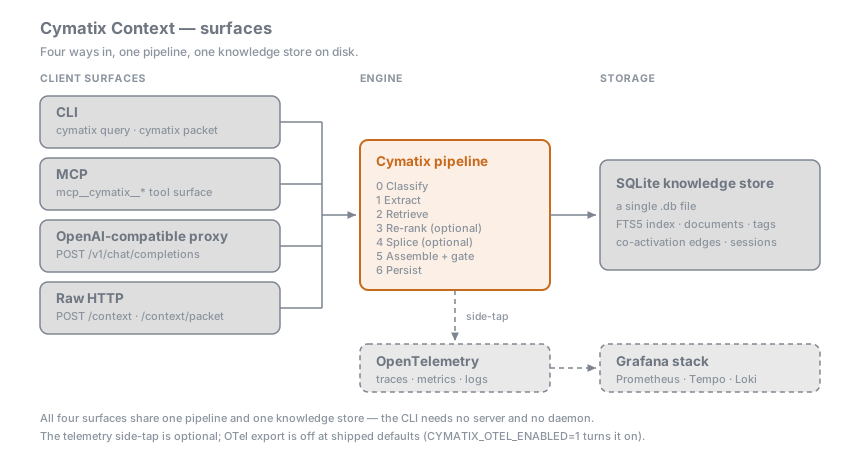
- A persistent knowledge store (legacy: genome) — one SQLite file — plus a seven-stage retrieval pipeline that assembles a token-budgeted context window per turn.
- Four ways in, all over the same retrieval primitives and the same JSON shapes: a CLI, an MCP tool surface, an OpenAI-compatible proxy, and raw HTTP.
- Every response carries an explicit agent contract:
know { found,
  confidence }
(grounded — you may answer) ormiss { reason, escalate_to }(not found — don't answer from the knowledge store). - The name comes from the engine's cymatics stage: each term is hashed (MD5) into one of 256 bins and given a small Gaussian spread, and query and candidate are compared as the resulting 256-dimensional vectors. "Cymatics" is a mnemonic for that binned spectrum, not a claim of signal-processing semantics — and the signal has not yet been isolated against hashed bag-of-words or random-bin controls. Treat it as an experimental cheap feature. Detail: Retrieval Dimensions.
Why it is built this way
- Local-first. SQLite plus FastAPI on one machine; the proxy binds
loopback (
127.0.0.1:11437) by default. The published operating point is 829,131 fragments ingested on a single consumer desktop — on the unsharded engine. The sharded path currently trails unsharded by ~31pp recall@10 / ~30pp MRR on the xl bed (#275), so prefer unsharded for accuracy-sensitive corpora. - LLM-free by default on the retrieval path. Dense (BGE-M3), SPLADE, and PKI all ship default-off since 2026-08-15..19, each flip receipt-gated; the cross-encoder rerank has always shipped default-off. The only model stage is the optional splice/compressor (legacy: ribosome), which is disabled by default. See Pipeline.
- A know/miss contract instead of a similarity score. The contract
shape is stable and load-bearing. The
confidencescalar is under active recalibration and is not a reliable trust signal on current internal beds (#287, #239) — rely onfound/reasontoday. See Agent Contract. - Token economics. With the compressor disabled (the default LLM-free
config), across N=15 query shapes measured May 2026: median 2,757
tokens per turn, 2.9× fewer than standard RAG (top-5 × 1,500 + 500
overhead = 8,000 tokens). Caveat: that denominator is a configurable
modeled baseline, not a measured competitor run; the multi-turn figures
(~40% savings, 37× on repeated retrievals) are unverified design
estimates pending the
cymatix_session_tokens_saved_totalcounter. Reproducer and the full table: Benchmarks and Receipts. - One file on disk. The knowledge store is a single SQLite database in
WAL mode with FTS5 (default
genomes/main/genome.db). Back it up by copying the file; delete it to start fresh. - Receipts culture. Defaults change only behind a measurement, and the
disclosures that cost something get published too — turning dense off
carries a measured p50 latency regression (×2.5–2.6 at 100k fragments,
shrinking to ×1.09–1.38 at the 829k operating point,
#374); the
mitigation has not landed. The ledger is
docs/benchmarks/BASELINES.md.
Pages
Start
| Page | What's on it |
|---|---|
| Getting Started | Requirements, extras decision table, four-command quickstart, three workflows |
| Troubleshooting | The recurring failure modes as symptom → fix, plus the gotcha list |
Concepts
| Page | What's on it |
|---|---|
| Pipeline | The seven stages, what's optional, what's algorithmic vs model |
| Retrieval Dimensions | The dimension table, RRF vs additive fusion, the cymatics honesty note |
| Agent Contract | know/miss shape, the prompt fragment, freshness downgrades, packet semantics |
| Architecture Map | Package layout, knowledge-store shape, session registry, storage notes |
| Lexicon | Biology-to-software vocabulary mapping and what stays legacy on the wire |
Reference
| Page | What's on it |
|---|---|
| Configuration | Every cymatix.toml section, defaults, flip dates, env precedence |
| HTTP API | Endpoint tables, a full /context/packet example, security knobs |
| CLI | Command table, the --json agent workflow, status / diag corpus |
| MCP and IDE Integration | MCP config, tool roster, Claude Code, Continue, OpenAI proxy |
| Observability | Setup scripts, enable precedence, Grafana dashboards, metric families |
Project
| Page | What's on it |
|---|---|
| Benchmarks and Receipts | Token economics, shipped-defaults numbers, encoder-isolation receipts, comparability rules |
| Roadmap and Releases | 0.9.2 release highlights, published 0.9.1 history, 0.9.0 disclosures, deferred ledger, versioning |
Elsewhere
- Site: https://cymatixcontext.com
- Repository: https://github.com/mbachaud/Cymatix-Context
- Package: https://pypi.org/project/cymatix-context/
- Discord: https://discord.gg/pX7x7pA3Da
Go deeper
README.md— the short version, with the proof tabledocs/MISSION.md— what the project is actually trying to dodocs/DESIGN_TARGET.md— why the primary consumer is an LLM agent, not a human readerdocs/SETUP.md— the canonical install path- Next: Getting Started · Pipeline · Benchmarks and Receipts