Benchmarks and Receipts
- This page owns the numbers. Every other wiki page that quotes a figure links back here for the measurement it came from, the arm it was measured against, and the caveat it carries.
- A default only changes behind a measurement. Each of the encoder default-off flips in 0.9.0, the RRF fusion default of 2026-07-06, and the wave-1 ranking flip in 0.9.1 is gated on a receipt with a named arm, a pinned bed, and order-reversed replication.
- The disclosures that cost something get published too. Turning dense off bought recall and lost p50 latency, and that regression is in the CHANGELOG, the README, and this page — not in a footnote nobody reads.
- A receipt without a ledger row is not comparable to anything. The rules are
in Comparability rules below and enforced in
docs/benchmarks/BASELINES.md. - Some things are measured, some are estimated, and the two are labelled differently. Where a figure is an unverified design estimate, this page says so on the same line as the figure.
Token economics
Measured with the compressor (legacy: ribosome) disabled — that is, the default LLM-free configuration. N=15 query shapes, May 2026.
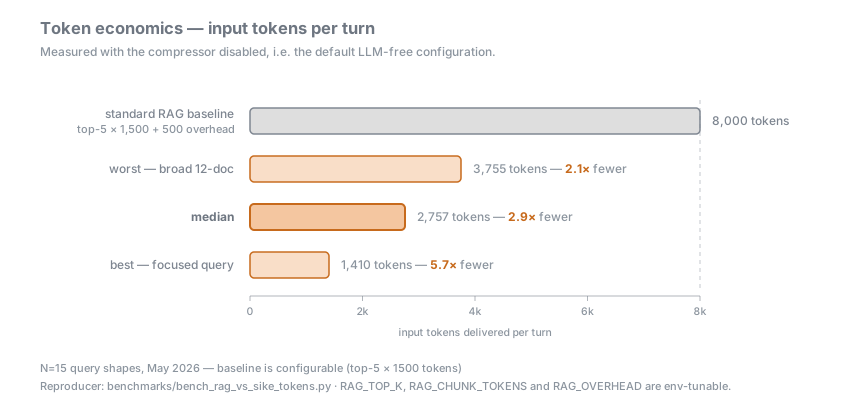
| Query shape | Tokens per turn | vs the standard-RAG baseline |
|---|---|---|
| Best — focused query | 1,410 | 5.7× fewer |
| Median | 2,757 | 2.9× fewer |
| Worst — broad 12-document window | 3,755 | 2.1× fewer |
- The denominator is a model, not a competitor run. "Standard RAG" here is
top-5 × 1,500 + 500 overhead = 8,000 tokens. It is a configurable modeled
baseline —
RAG_TOP_K,RAG_CHUNK_TOKENSandRAG_OVERHEADare env-tunable in the reproducer — not a measured run of another system. - Reproducer:
benchmarks/bench_rag_vs_sike_tokens.py, run against your own knowledge store. - The multi-turn figures are unverified design estimates. The session
delivery register elides already-delivered documents; ad-hoc session traces
showed a 37× reduction on repeated retrievals within a conversation and
~40% token savings on typical multi-turn work. Neither is a receipted
benchmark. The counter that would measure them —
cymatix_session_tokens_saved_total— is instrumented but has no published run; see Observability. Treat both figures as design estimates until it does. - The 37× is elision, not compression. It counts bytes the register declined to re-send, not new content squeezed smaller.
- What is not published: a same-harness baseline/ablation frontier — BM25, BGE-M3, BM25+dense RRF, Cymatix full, Cymatix minus-cymatics — paired with correctness. That is the comparison that would settle the decision-useful claim ("equal-or-better task completion at fewer input tokens"), and it is future work.
Shipped-defaults operating point (0.9.0)
What an untouched 0.9.0 install did, measured on the 829K-fragment EnterpriseRAG-Bench bed at full needle power. The default retrieval path is fully algorithmic here — dense, SPLADE and PKI all off, the cross-encoder rerank off as it always has been.
| Metric (829k bed, n=469, delivered basis) | Score |
|---|---|
| Gold-document delivery | 56.5% (265/469) |
| recall@12 | 0.659 |
| final recall@12 | 0.663 |
| median gold rank | 3.0 |
- Receipt:
benchmarks/dogfood/erb/receipts/sema_readgate_829k_n469.json, ledger row2026-08-19-sema-readgate-decider. - This is a retrieval-layer measurement, not an end-to-end grade. It says how often the gold document reached the delivered window. It does not say whether the answer was right — see The ERB pair-quote rule.
- The abstain set on this run was 16 of 469, all
score_below_floor, and byte-identical to the baseline's zero-delivery set. - The 0.9.1 defaults are measured in the next section, as their own rows.
0.9.1 measurements
All four shipped in the 0.9.1 release (2026-08-30); each is cited by PR number.
The release gate itself is ledger row 2026-08-30-v091-gate-sweep — three config
arms over four beds, receipt
benchmarks/dogfood/receipts/sweep_v091_gate_2026-08-30.json, ALL PASS.
Delivered basis, paired per needle:
| Bed | Frozen 0.9.0 defaults | Wave-1 flip, floor 0 | + min_delivered_docs = 12 (the shipped 0.9.1) |
|---|---|---|---|
| EnronQA v2 (84,677 documents, n=500) | 0.694 | 0.820 (+66 / −3) | 0.856 (+18 / −0) |
| EnronQA padded (596,707 documents, n=500) | 0.702 | 0.776 (+41 / −4) | 0.792 (+8 / −0) |
| ERB 100k carve (n=141) | 0.6099 | 0.6312 (+7 / −4) | not run |
| ERB 829k v09x (n=470) | 0.5553 | 0.6298 — reproduces the wave-1 confirm to the digit (Δ = 0.0) | 0.668 (+18 / −0) |
The exact reproduction on the 829k bed is the witness that the rest of the
merged stack (#406, #408, #409's knob, #412, #413) is inert at shipped defaults
there. All beds in this row are tagger_version = 1.
Wave-1 ranking flip (#407)
rrf_k 60 → 20, and rerank_combinator_by_class extended to all five classifier
classes mapped to eps_band. Full-470 confirm at 829k scale:
| Metric | Before | After |
|---|---|---|
| Gold-document delivery | 0.555 | 0.630 (+43 / −8 paired) |
| recall@12 | 0.651 | 0.681 (+18 / −4) |
| Median gold rank | 3 | 2 |
| Question-type regressions | — | zero |
- The post-flip repository
cymatix.tomlwas verified field-identical to the measured arm config throughload_configequality, and both confirm receipts carry post-runconfig_sha256annotations. - One-step revert:
git revert 7a42576restores the previous defaults. The flip ships as a single named commit for exactly that reason. - The cross-shard merge constant deliberately stays at 60 — that surface was never measured, and is annotated as unmeasured in the code rather than flipped on faith.
- Ledger row
2026-08-27-ranking-under-width-wave1records the bed identity,ingest_c = 6, the cold-bed house rule, and the warm-bed access-rate hazard. Thatingest_cdiffers from the shipped-defaults row above, so the ledger's own rules do not license reading 0.630 as a successor to the 0.565 in the previous section — they are different rows.
Delivered-seat floor (#409) — knob shipped, then graduated 0 → 12
[budget] min_delivered_docs, default 12 since 2026-08-30 (the commit
subject-tagged [w24-floor-flip]); 0 restores the byte-identical legacy
eviction-only trim. At floor 12, on the same 470-needle sequence as the wave-1
confirm:
| Metric | Wave-1 baseline | Floor 12 |
|---|---|---|
| Gold-document delivery | 0.630 | 0.668 (+18 / −0) |
| Completeness slice | 0.65 | 0.85 |
| Constrained slice | 0.80 | 0.97 |
| Semantic slice | 0.31 | 0.34 (+4 / −0) |
| Median delivered count | 8 | 12 |
| Needles under 12 seats | 383 | 152 (remainder pool-limited) |
- Zero losses anywhere, and the map and final-rank bases are byte-identical per-needle — this is a pure delivery change, not a ranking change.
- The flip was taken after a cross-corpus confirm, not on the 829k row
alone: EnronQA v2 0.820 → 0.856 (+18 / −0) and EnronQA padded 597k
0.776 → 0.792 (+8 / −0) — three corpora, zero paired delivered losses,
recall@12 / final recall@12 identical in every cell (ledger row
2026-08-30-v091-gate-sweep,v091_floorarm). Revert is onegit revertof the flip commit. - What the receipts still do not grade: answer quality under a widened seat count. Twelve full-length documents per window costs real tokens, and ERB does not grade that trade — the answer-quality lane is still owed.
- The plan doc for this arm also records a mid-flight diagnosis correction: the
original token-budget attribution was refuted by an effective-lever probe
(budget tier
broad, hard floor uncrossed, zero evictions), and the classifier's per-rule assembly cap was pinned as the real lever before any bench compute was spent on the wrong fix.
Entity auto-link hub cutoff (#412) — knob shipped at 0, flipped to 200 in 0.9.2 (#425)
[ingestion] entity_autolink_hub_cutoff shipped in 0.9.1 at default 0
(off = legacy behavior, pinned byte-identical by test) and flips to 200
in 0.9.2 via #425; 0 stays the opt-out. Read-only replay on the 289k-document
enronqa_padded bed, seed 53416, 500 linkable documents:
| Measurement | Value |
|---|---|
| Hub cardinality at cutoff 200 | 0.53% of distinct entities (1,884 of 357,406) hold 56.9% of all 3.72M postings |
| Mean per-link call | 210.5 ms → 0.62 ms (~340×) |
| p95 per-link call | 419.8 ms → 1.07 ms |
| Ingest wall-time share before the fix | 148.9 ms/insert = 89.5% of writer wall time |
- Why the default stayed 0 in 0.9.1: the edge delta is substantial. On the
sample, the uncut arm formed 4,842
relation=5COVER edges; at cutoff 200 it forms 2,867 — 3,143 lost, 1,168 gained, 1,699 kept. That is a real change to the graph, so the knob shipped opt-in with the receipt attached and the flip waited for its conditions. - The mitigating context, not a justification: COVER edges are default-inert at query time — the wave-2 COVER-walk arm was killed by its own receipt — and they are already order-nondeterministic under parallel ingest.
- The retrieval-side condition has since been measured null. A paired
EnronQA A/B (n=500; beds
enronqa_bed_v2vsenronqa_bed_v2c, differing only in the cutoff, gene-id-set digests identical) came back with delivered, recall@12, final recall@12, and median rank identical to full precision in both the 0.9.0 and 0.9.1 configs — 0/500 per-needle delivered flips (ledger row2026-08-30-entity-hub-cutoff-retrieval-ab). It pairs with a ~5× end-to-end build win on the padded bed (4h58m against a ~26h trajectory). - The second flip condition — the hubs survive tagger v2 — is also
measured. Paired 500-document replays on content-identical 85k beds, one
tagger-v1 and one tagger-v2
(
benchmarks/dogfood/receipts/entity_hub_cutoff_reprobe_85k_taggerv1_2026-08-30.json,…_reprobe_85k_taggerv2_2026-08-31.json; ledger row2026-08-31-entity-hub-cutoff-reprobe-85k): tagger v2 removes 15.2% of distinct entities (239,302 → 202,844), but the natural hub population persists and grows slightly (enron15,397 → 16,048 postings). At cutoff 200, 0.22% of entities still hold 30.1% of postings; the mean per-link call falls 4.15 → 0.42 ms. - Flip conditions were specified on
#411; with both
receipted, the flip itself — default
0 → 200— ships in 0.9.2 via #425. The 0.9.1 default was0;0remains the opt-out.
Tagger v2 (#413) — a behavior change with a version bump
The CPU ingest tagger now rejects entities containing newlines or tabs, plus
email/MIME header field names, x-* extension headers, and MIME transport
artifacts. Fresh receipt on a 2,000-file deterministic EnronQA sample, seed
20260830:
| Metric | v1 | v2 |
|---|---|---|
| Entity-graph rows | 35,032 | 29,197 (−16.7%) |
| Multi-line entity occurrences | 2,818 | 0 |
| Top hub | content-type (1,711 documents) |
enron (740) |
enron rows (survival) |
712 | 740 |
| Document ids equal | — | true (content untouched) |
| Documents with a changed tag multiset | — | 2,235 / 2,779 |
- This is a comparability break by design. Tags are part of the bed-content
digest, so
TAGGER_VERSION = 2is declared in the tagger module, recorded in every bed manifest byscripts/build_fixture_matrix.py, and added to the BASELINES rules. Every bed built before 2026-08-30 istagger_version = 1and stays internally valid but is not cross-comparable with a v2 bed. - There is no backfill script on purpose — stripping entities in place would create hybrid v1/v2 beds. v2 beds are fresh builds.
The ERB pair-quote rule
The public leaderboard entry is the external number of record. On the EnterpriseRAG-Bench leaderboard (every entry judged by GPT-5.4; Onyx excludes itself), Cymatix-Context scores:
| ERB leaderboard (v0.6.3/0.6.4; rank 23 of 26 as of the 2026-09-18 update) | Score |
|---|---|
| Overall | 33.93 |
| Correctness | 42.2 |
| Completeness | 42.74 |
| Document Recall | 50.7 |
v0.6.3 is the frozen external-validation snapshot (see the 0.6.4 entry in the CHANGELOG). No later version has been resubmitted.
The internal run below was graded under ERB's official judge protocol but is not the leaderboard entry. It was measured under the 0.8.x all-encoders-on configuration — additive fusion + dense + SPLADE ON — which no longer ships by default. Every layer remains available opt-in.
| ERB official judge protocol, internal run (July 2026, 0.8.x config) | Score |
|---|---|
| Correctness | 41.6% (208/500) |
| Completeness | 42.8% |
| Overall | 33.57 |
Quote the delivery and correctness numbers as a pair. Under that same all-encoders-on config:
- Gold-document delivery was 55% at 829K-fragment scale and 82% at 50K.
- Delivery is not a graded pass. End-to-end correctness is the 41.6% above.
- When the gold document was delivered, the answer was correct 79% of the time — so retrieval breadth at extreme scale, not answer synthesis, is the current ceiling.
- The end-to-end judge protocol has not been re-run on shipped defaults. The measurement of the shipped world is the delivered-basis table above, and it is a retrieval-layer metric. Do not blend the two.
The claim being made is the operating point — the corpus was ingested as
829,131 fragments on a single consumer desktop with zero LLM calls on the
retrieval path — not a leaderboard win. Full methodology and reproduction:
docs/benchmarks/2026-07-10-erb-blob-829k-reproduction.md.
Why the encoders are off
Four flips took the default retrieval path fully neural-free, each on its own receipt.
| Flip | Date | What the receipt measured |
|---|---|---|
[retrieval] dense_embedding_enabled → false |
2026-08-15 | Four-scale isolation (100k/250k/500k carves + 829k blob at the full 469-needle set, every order-reversed pair replicated exactly): BGE-M3 dense recall displaces gold from the delivered top-k at every scale, final recall −0.20 .. −0.33 vs the lexical floor (−0.207 at n=469, ~97/469 needles), while adding at most +0.02 candidate-pool recall |
[ingestion] splade_enabled → false |
2026-08-16 | n=469 on the 829k blob over the full 147M-row expansion index: null-to-negative vs the lexical floor — pool −0.004, delivered −0.006, ~15% slower, both repeats identical. The ingest-side bed A/B showed the expansion index contributes nothing passively |
[retrieval] pki_enabled → false |
2026-08-17 (#370) | 829k exact-shipped-default confirm at full power (n=469, delivered basis): PKI on is −1 delivered needle (263/469 vs 264/469). Honest caveat: the earlier n=30 100k cell was +1 delivered needle for PKI, replicated in both run orders — the one positive cell |
[ingestion] sema_embed_on_ingest / dense_embed_on_ingest → false |
2026-08-19 (#371) | Ingest-time only. The sema deciding cell was a wash (+1 delivered needle at 829k n=469, rank bases byte-identical); the dense write was dead at neural-free retrieval defaults — removing it gave a 6.1× ingest wall speedup and −2.6 GB RSS on the 12-file harness smoke |
- The lexical floor is most of the product. All-off scored 0.767–0.867 final recall@12 across the four scales; no isolated layer beat it on final ordering anywhere except SPLADE's single needle at 250k — and on the delivered basis even that inverts (250k is SPLADE's worst cell, −0.133).
- A basis correction is part of this receipt's history
(#375). Earlier
revisions labelled
fr@12"final (delivered) recall, the metric that matters." That was wrong:fr@12is final-order recall; the post-budget-trim delivery slice isdelivered_gold_rate. The correction addendum republishes the tables on the delivered basis. Dense's harm and the lexical-floor finding hold; SPLADE's one apparent win inverts. - Opting back in is one config line per store. Existing beds keep their
vectors and expansion tables — unused until you set the flag. If a bed was
built while the ingest-side knobs were off, re-enabling retrieval also needs
scripts/backfill_bgem3_v2.py(dense) orscripts/backfill_sema.py(SEMA). - Full receipt:
docs/benchmarks/2026-08-14-encoder-isolation-scale-curve.md.
The latency disclosure (#374)
- Turning dense off costs p50 latency. Dense was load-bearing as a latency device: its ANN gate capped the candidate list feeding splice, and dense-off degrades the median query to an uncapped lexical pool.
| Scale | Dense-off p50 vs dense-on |
|---|---|
| 100k fragments | ×2.5–2.6 (10.4s / 9.7s vs 3.9s / 3.8s) |
| 250k | ×2.3–2.4 |
| 500k | ×1.27–1.37 |
| 829k (the published operating point) | ×1.09–1.10 at n=30; ×1.15–1.38 on the full-power n=469 pair |
- The retrieval-layer ledger's own precondition — "cap the non-ANN branch's candidate list before dense-skip is viable" — has not landed. The lex-branch candidate cap is still open, alongside the related #336 splice char-target dynamics.
Other standing receipts and gaps
- Fusion. Reciprocal Rank Fusion has been the default ranker since
2026-07-06 — +12pp gold-document delivery over the legacy additive
accumulator on the hardest internal bed (0.74 vs 0.62). Mechanism and the
"additive"deprecation status: Retrieval Dimensions. - Cross-encoder rerank (#341) ships default-off deliberately: it pays only on populations with near-cutoff rerank headroom, and costs ~270–560 ms/query on a GPU daemon at 829k documents (~285–315 ms at 100k).
- Control-tag neutralization was flipped on a null receipt, which is the point: the 141-needle 100k-carve A/B measured 141/141 assembled windows byte-identical across arms, recall and delivered rate unchanged to four decimals. A security default that changes retrieval would not have shipped.
- The know surface is coverage-dead at shipped defaults. 0 of 141 know
emissions versus 23 of 141 with the pre-flip encoders on, because
lexical_dense_agreeis structurally dead on the neural-free path. It fails in the safe direction (0% false-KNOW) and is tracked as #287. Detail: Agent Contract. - The sharded gap (#275): every headline number on this page runs the unsharded engine. The sharded path currently trails unsharded by ~31pp recall@10 / ~30pp MRR on the xl bed — dense recall and co-activation are not yet at parity across shards. "Local-first at scale" is a demonstrated research operating point on the unsharded engine, not a turnkey substrate for sharded corpora.
- The entity-graph layer ships ON and has never been ablated on the delivered basis — the retrieval-layer ledger classes it REMOVE-CANDIDATE and the arm sits in the #377 0.9.x backlog.
- End-to-end answer accuracy with Claude answering. No Haiku or Sonnet
answer-accuracy run exists on current defaults. The only committed
Claude-answered receipts are the July 2026 SIKE sweeps (pre-rename tree, n=50
needles per bed, Sonnet answering, deterministic accept-substring scoring, no
LLM judge): 21/50, 23/50 and 18/50 correct on the 42k, 16k and 80k beds,
with 0.70 / 0.85 / 0.82 correct among answered questions and the rest
abstained
(
docs/research/data/2026-07-11-sike_bedsweep_*.json). Historical context, not a current score.
Two reading rules the receipts forced
- Check
delivered_countbefore crediting a delivered-gold gain. A small class of queries discards a rank-1 gold document with an empty delivered window. Any perturbation that flips one back on looks like a retrieval win and is not one. - Rank-based recall cannot see delivery. Signals that pull documents forward after ranking, and gates that trim the window before assembly, are both invisible to recall@k by construction. That is why the 0.9.x work reports the delivered basis, and why the #375 correction mattered.
Comparability rules
From the 2026-08-09 receipt invalidations onward, the ledger enforces:
- Compare arms only within their own row. Cross-row comparison is not licensed by default, even when the metric names match.
- Measure against a frozen tag, never a moving branch.
- A receipt without a row in the ledger is not comparable to anything.
ingest_c— ingest concurrency — is part of bed identity. Parallel ingest is not bed-equivalent: pool=4 LLM tagging versus pool=1 on a pinned corpus changed document content on 105 of 150 shared documents and tag multisets on 86 of 150, at temperature 0 (LLM-batching drift; the controls held). Every bed records the concurrency it was built at;unknownis a legal value meaning not-comparable-across-beds. Comparable rebuilds ingest sequentially unless the comparator was itself built parallel.tagger_versionis part of bed identity too (added by #413). Cross-bed comparisons require matching versions; every bed built before 2026-08-30 is v1.- Bed-state note (2026-08-20 ops). The two 829k beds were rebuilt after the
†-marked ledger rows ran —
path_key_indexdropped, FTS5 migrated to external-content, vacuum. Retrieval-signal impact is nil by design (a byte-identity receipt covers it, and PKI is read-gated off at shipped defaults), but bed-bytes and storage numbers from †-rows are not comparable to post-ops measurements, and reproducing a PKI-on arm against the post-ops beds requiresscripts/backfill_path_key_index.pyfirst. - Release receipts run shipped defaults by construction — daemon off, workers 2 — because they certify what an untouched install does. The standard bench profile (encoder daemon on, per-box worker counts) is for comparative work and is a documented exception, not the release path.
Large captures, gitignored research outputs, and archived knowledge-store snapshots are mirrored to the companion repository https://github.com/mbachaud/cymatix-receipts — private while its bed contents are audited; ask the maintainer for access.
Why the benchmarks look like this
Standard needle-in-a-haystack was built for a different class of system, and running it against a multi-axis index measures the wrong thing:
- NIAH assumes exactly one correct answer. On a corpus where thousands of
documents legitimately answer "what is the value of
url?", grading a hit only when the retriever returns the one document the bench randomly picked scores a perfect system near zero. Telepathy is not a retrieval property. - NIAH assumes recall@1 is the right metric. A query that specifies one axis leaves the other signals with nothing to work with; recall@1 grades that as breakage.
- NIAH assumes the query maps to one dense vector. Real queries carry several narrowing signals that compose multiplicatively — project, then component, then target attribute.
The replacements, both maintained:
| Question | Bench |
|---|---|
| Does the multi-axis index compose correctly as narrowing dimensions are added? | bench_dimensional_lock.py — a four-variant axis-count gradient where the curve shape is the diagnostic, not any single point |
| Does the system work at scale on real-shape queries over a leak-free corpus? | EnterpriseRAG-Bench — natural enterprise questions with explicit gold-path lists, graded when any valid gold appears in the delivered citations |
| Does the system work for real users? | SIKE — natural queries at normal axis density |
The multi-valid-gold rule is what makes ERB gradable at all; it is documented at
docs/benchmarks/MULTI_VALID_GOLD.md.
Go deeper
docs/benchmarks/BASELINES.md— the ledger: one row per campaign, the comparability rules, the standard bench profile, and the code pinsdocs/benchmarks/BENCHMARK_RATIONALE.md— the full why-NIAH-doesn't-fit discovery doc and the dimensional-lock designdocs/benchmarks/2026-08-14-encoder-isolation-scale-curve.md— the four-scale isolation receipts, the latency table, and the #375 basis correctiondocs/benchmarks/2026-08-06-retrieval-layer-ledger.md— the dated cost-versus-impact audit of every retrieval layer, with its scope limitsdocs/benchmarks/2026-07-10-erb-blob-829k-reproduction.md— the 829K-fragment ERB methodology and reprodocs/benchmarks/2026-07-06-sike-run2-fts-depth-fusion.md— the RRF-versus-additive receiptdocs/benchmarks/2026-08-07-rerank-wiring-receipts.md— the cross-encoder rerank cost and its population caveatdocs/benchmarks/BENCHMARKS.md— the practical harness referenceCHANGELOG.md— every flip entry with its receipt path and its re-opt-in story- Next: Retrieval Dimensions · Configuration · Roadmap and Releases · Observability