Retrieval Dimensions
- Retrieval is not one score. It is a set of independent signals — nine numbered dimensions plus a few auxiliary tiers — that each nominate and weigh candidates, and are then combined by a single fusion step.
- Every dimension runs on deterministic CPU math. There is no model call anywhere on this page's subject matter; the opt-in encoders (dense, SPLADE) are the only neural components, and both ship off.
- The list below is the inventory. Whether a dimension actually fires at shipped defaults is the "default state" column — and several do not.
- Each default-off state is receipt-gated: a measurement decided it, and the measurement is linked. The corresponding cost figures are on Benchmarks and Receipts.
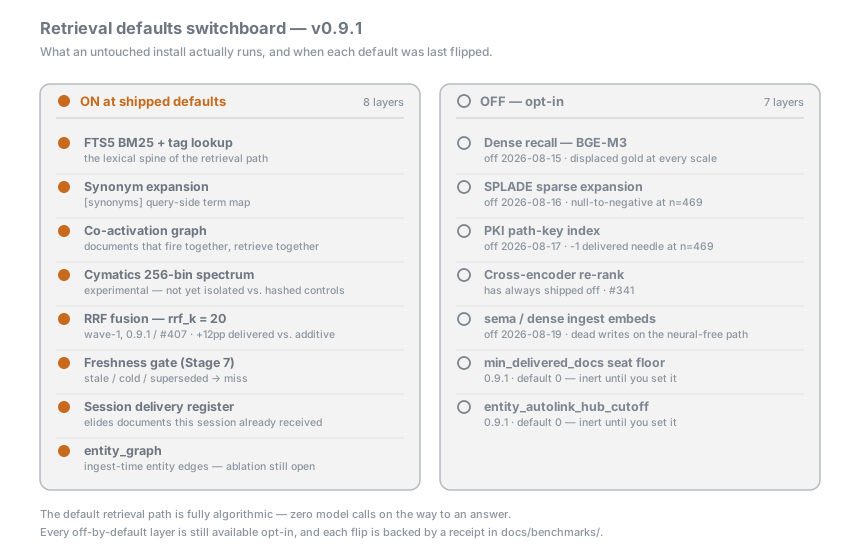
The dimensions
| Dimension | Signal | Cost | Default state (v0.9.1) |
|---|---|---|---|
| D1 Semantic content | FTS5 BM25 over document text; SPLADE sparse term expansion; SEMA 20-dim cosine as a cold fallthrough | A primary query cost — the lexical backbone the best-scoring arms lean on | FTS5 on. SPLADE off since 2026-08-16. SEMA cold tier off ([context] cold_tier_enabled) |
| D2 Tagging | Exact and prefix lookup against the ingest-time tag index, with query terms expanded through [synonyms] |
ms-scale at 100k; a substantial per-query cost at 829k in the dated ledger | on |
| D3 Source provenance | source_id deny-list gate at the storage boundary, plus a per-source authority weight in fusion |
negligible | on — provenance fields auto-populate at ingest |
| D4 Working-set access rate | Sliding-window access-rate over a ring buffer of recent accesses, applied as a capped tiebreaker | negligible | on (tiebreaker only) |
| D5 Lifecycle tier | Three-tier accessibility — hot / warm / cold (legacy: open / euchromatin / heterochromatin) — filtering which documents are even queried | negligible (a filter) | on; hot + warm queried, cold excluded unless opted in |
| D6 Cymatics | MD5-hashed 256-bin term spectrum: resonance overlap, flux integral, harmonic-bin boost | microseconds, LRU-cached | on — blended as a capped bonus, not used to re-sort |
| D7 Document attribution | party_id scoping gate over attributed documents; citation enrichment with the authoring party and handle |
negligible | on where identity is known; authorship-class scoring is not live |
| D8 Co-activation graph | Harmonic spectral edges (Tier 5); shared-entity edges (Tier 5b); SR graph expansion; seeded edges | harmonic small; the gated reads cost nothing while off | harmonic on; entity-graph retrieval off; SR off; seeded edges off |
| D9 Temporal context (TCM) | Per-session drift vector that lightly re-sorts already-retrieved candidates | negligible | on as a tiebreaker; theta-biased ray tracing off |
Auxiliary tiers that fire but are not numbered dimensions:
- Path-key index (Tier 0) — compound
(path_token, key)lookup.[retrieval] pki_enabledoff since 2026-08-17 (#370). - Filename anchor — a lexical boost on filename matches, on since 2026-04-22.
- Lexical IDF anchor — an inverse-document-frequency anchor over the tag index. It issues its own probes outside the D2 tag gate, so disabling the tag tiers does not stop the tag table being read.
- Stage-2 dense recall (BGE-M3) —
[retrieval] dense_embedding_enabledoff since 2026-08-15.
Fusion: how the signals become one ranking
- Reciprocal Rank Fusion is the default ranker and has been since 2026-07-06. Each signal contributes a rank, not a raw score, so no hand-picked exchange rate has to hold across tiers with incompatible scales.
- The receipt: RRF measured +12pp gold-document delivery over the legacy additive accumulator on the hardest internal bed — 0.74 vs 0.62. The additive path mis-scales dense against the FTS5 BM25 cap, which is what the rank-level fusion removes.
fusion_mode = "additive"restores the pre-Stage-3 accumulator byte-identically. It is DEPRECATED-FOR-REMOVAL on a condition gate, not a calendar — v(N+2) at the earliest.- The per-tier weights in
[retrieval]bind in both modes: under"additive"they are the tier coefficients and caps themselves; under"rrf"they are rank post-multipliers. - Under RRF the abstain gates run ratio-only — the absolute score floors were calibrated against additive fusion and do not transfer.
Wave-1 ranking defaults (0.9.1, #407)
rrf_k60 → 20. A smallerksteepens the rank discount, so a candidate that any one signal ranks highly survives fusion instead of being averaged away.rerank_combinator_by_classextends to all five classifier classes (arithmetic,factual,procedural,multi_hop,default), each mapped toeps_band— post-fusion rerank signals break ties only inside a relative band of the leader's fused score.- Measured together on the 829k bed at n=470: gold-document delivery 0.555 → 0.630, recall@12 0.651 → 0.681, median gold rank 3 → 2, zero question-type regressions.
- The cross-shard merge constant deliberately stays at 60 — that surface was not measured, and is annotated as unmeasured in the code rather than flipped on faith.
Cymatics, honestly
- Each term is hashed (MD5) into one of 256 bins and given a small Gaussian spread; query and candidate are then compared as the resulting 256-dimensional vectors. It is a cheap, deterministic, model-free term transform.
- "Cymatics" is a mnemonic for that binned spectrum, not a claim of signal-processing semantics. Nearby bins are hash placement, not related meaning. There is no wave physics in the scoring.
- It is a candidate-reordering signal that has not yet been isolated against hashed bag-of-words or random-bin controls. Treat it as an experimental cheap feature, not a proven one.
- What has been measured, once: the 2026-08-06 ledger's re-run of the cymatics ablation on a 141-needle 100k carve found recall@12 and recall@5 identical across all six arms — shipped, off, collapsed-spread, and three random-bin seeds. The entire measurable effect was confined to sub-window ordering, and the shipped arm was not distinguishable from random binning — it beat the best random seed by 0.0012 MRR against a random-control band of width 0.0035, and tied that seed exactly on recall@1. The verdict was KEEP-CHEAP, not KEEP-PROVEN — one bed, one needle family, so the standing "not isolated" claim above still holds for the project as a whole.
- The binned vector is exposed directly by
POST /fingerprintif you want to look at it. See HTTP API.
What the retrieval-layer ledger measured
The 2026-08-06 retrieval-layer ledger is the cost-versus-impact audit of these layers: ablation ladder arms that self-validate by signal absence, a storage audit that maps GB to layers, and an adversarial council pass that re-probed the headline claims order-reversed. It is a dated document — these are its findings on its beds, not a statement of current shipped state, and several defaults have moved since.
| Layer | Ledger verdict (dated) | What happened since |
|---|---|---|
| FTS5 | KEEP-LOAD-BEARING | Still the default backbone |
| SPLADE | REMOVE for ERB-class serving — four scales, recall never crosses zero | Shipped default-off 2026-08-16 |
| Path-key index | REMOVE-CANDIDATE — neutral-to-positive to remove at both 100k and 829k, zero delivery flips | Shipped default-off 2026-08-17 (#370) |
| Tags (D2) | SPLIT — the delivered-gold gain at 100k did not replicate at 829k; the storage half is unmeasured | Still on; a no_lex_anchor arm (#355) is owed before any storage action |
| Cymatics | KEEP-CHEAP, now measured — indistinguishable from random binning | Still on, still labelled experimental |
| Co-activation / harmonic | TRIM-CANDIDATE — a post-rank pull-forward, invisible to rank-based recall@12 by construction | Still on; the delivered-basis metric it needs is now armed |
| Entity graph | REMOVE-CANDIDATE, plus a read-path flag leak the ledger found | Flag leak fixed; ingest-side edge building still ships on and has never been ablated on the delivered basis — deferred in the #377 ledger |
| SEMA (query-side) | REMOVE-CANDIDATE — null even after backfilling every vector | Ingest-side SEMA embedding default-off since 2026-08-19 |
| Synonyms | TRIM-CANDIDATE — the shipped map netted zero-to-negative on that bed: one entry load-bearing, two pool-bloating | Feature kept, map retune still open |
| Classifier | KEEP-CHEAP — recall-identical, and its cap shrinks splice input for free | Unchanged |
Standing scope limits on all of the above: 141 carve needles at 100k and 30 of 469 blob needles at 829k, one config profile, one needle family (needle-in-haystack). At blob scale one needle moves recall@12 by 0.033, so several of those verdicts rest on one-needle movements and say so.
Two reading rules the ledger's own receipts forced, worth carrying into any comparison you run:
- Check
delivered_countbefore crediting a delivered-gold gain. A small class of queries discards a rank-1 gold document with an empty delivered window; any perturbation that flips one back on looks like a retrieval win and is not one. - Rank-based recall cannot see delivery. Signals that pull documents forward after ranking, and gates that trim the window before assembly, are both invisible to recall@k by construction — which is why the delivered basis is the metric the 0.9.x work reports.
Where to change these
- Every knob named on this page lives in
cymatix.tomlunder[retrieval],[ingestion],[context],[cymatics], or[synonyms]. Defaults, flip dates, and env-var precedence: Configuration. - If a query returns nothing, the usual cause is D2, not D1: the query's
keywords never map to the tags assigned at ingest. Add entries to
[synonyms]— and re-read the ledger row above before adding many. Symptom-first version: Troubleshooting.
Go deeper
docs/architecture/DIMENSIONS.md— the formal dimension inventory, per-lane implementation status, and the decision gates each lane must cleardocs/architecture/PIPELINE_LANES.md— which table each signal reads at query timedocs/benchmarks/2026-08-06-retrieval-layer-ledger.md— the full cost/impact ledger, its addenda, and its scope limitsdocs/benchmarks/2026-08-14-encoder-isolation-scale-curve.md— the four-scale receipts behind the dense and SPLADE default-off flipsdocs/benchmarks/2026-07-06-sike-run2-fts-depth-fusion.md— the RRF-versus-additive receiptdocs/benchmarks/BASELINES.md— the comparability ledger every bed row is pinned against- Next: Pipeline · Configuration · Benchmarks and Receipts · Architecture Map