Pipeline
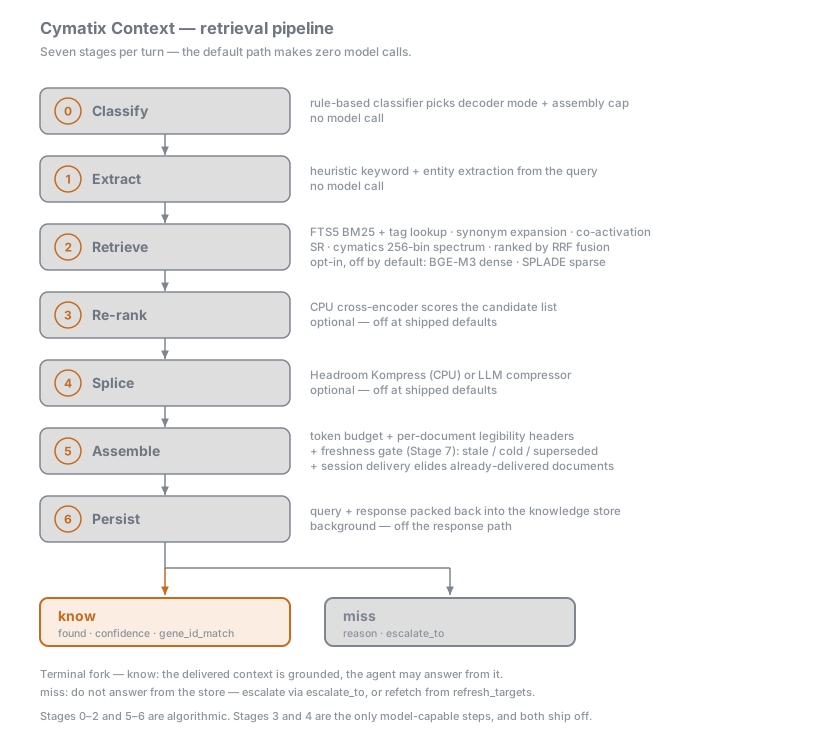
- Seven stages run per turn. Stages 0–2 and 5–6 are algorithmic — deterministic CPU math, no model call. Stages 3 and 4 are the only model-capable steps, and both ship off.
- So the default retrieval path makes zero model calls on the way to an
answer. The one LLM in the system is the downstream model that consumes the
assembled window — reached through
POST /v1/chat/completions, or through whatever agent called/contextin the first place. - Every turn ends at the same fork:
know { found, confidence, gene_id_match }ormiss { reason, escalate_to }. See Agent Contract. - This page documents v0.9.2. The wave-1 ranking flip
(#407) and the
min_delivered_docsseat floor (#409) shipped in v0.9.1 (2026-08-30) and are marked where they appear.
Stage 0 — Classify
- A rule-based classifier assigns the query one of five classes:
arithmetic,factual,procedural,multi_hop,default. Algorithmic — pattern scans over the query string, no model call. - The class selects the decoder mode for the turn and the per-rule assembly cap that bounds how many documents reach the window.
- Decoder mode is resolved from the class and the caller, not the class
alone. For the default
genericcaller the modes areminimal(arithmetic),condensed(factual),full(procedural,multi_hop), and none at all fordefault. Asmall_moecaller gets its own slate-shaped modes for the same classes. Callers select their branch withcaller_model_class— see HTTP API. [classifier] enabledis the only toggle that ships. Per-class caps and decoder hints are code constants, not config, pending #205. With the classifier disabled, every query takes the global path.- The 2026-08-06 retrieval-layer ledger graded this stage KEEP-CHEAP: recall-identical, and its cap shrinks the splice input for free.
Stage 1 — Extract
- Heuristic keyword, domain, and entity extraction from the query — the same CPU tagger (spaCy NER + EntityRuler + regex) that runs at ingest. Algorithmic.
- A caller-supplied
session_contextcontributes path tokens, which are injected into the entity set. Those tokens are what later give/context/packetits coordinate-confidence signal, so supplying them materially changes retrieval — an HTTP A/B that variessession_contextis not a clean ablation of anything else. - The one optional model call on this path: query-intent expansion, gated
by
[compressor] query_expansion_enabled(legacy:[ribosome]). It fires once per novel query string, is LRU-cached, and falls back to the raw query on any failure. Set it tofalsefor a strictly model-free/context./context/packetnever invokes it — the agent-safe surface is model-free end to end.
Stage 2 — Retrieve
- The whole ranking surface, and entirely algorithmic. Candidate signals
that fire at shipped defaults: FTS5 BM25 over document content, exact and
prefix tag lookup,
[synonyms]query expansion, an IDF lexical anchor, a filename anchor, harmonic co-activation edges, the cymatics 256-bin term spectrum, TCM session drift, ray-trace evidence, and an access-rate tiebreaker — plus aparty_idscoping gate. Detail per signal: Retrieval Dimensions. - Opt-in, off at shipped defaults: BGE-M3 dense recall (
[retrieval]
  dense_embedding_enabled
, off since 2026-08-15), SPLADE sparse expansion ([ingestion] splade_enabled, off since 2026-08-16), and the Tier-0 path-key index ([retrieval] pki_enabled, off since 2026-08-17). Each flip is receipt-gated; the receipts are on Benchmarks and Receipts. - Fusion. Candidates are ranked by Reciprocal Rank Fusion, the default
since 2026-07-06 — measured +12pp gold-document delivery over the legacy
additive accumulator on the hardest internal bed (0.74 vs 0.62).
fusion_mode = "additive"restores the pre-Stage-3 accumulator and is scheduled for condition-gated removal (v(N+2) at earliest, not a calendar date). - Wave-1 ranking default (0.9.1,
#407):
[retrieval]
  rrf_k
moves 60 → 20, tightening the rank-position discount so high-ranked candidates from any one signal survive fusion. The cross-shard merge constant deliberately stays at 60 — that surface is unmeasured and is annotated as such in the code.
Stage 3 — Re-rank
- Optional, and off. Two different things are called "rerank" here, and only the first involves a model:
- Cross-encoder rerank — a CPU cross-encoder (
ms-marco-MiniLM-L-6-v2) scores the candidate list.[retrieval] rerank_enabledhas always shippedfalse(#341); with it off, this stage is skipped entirely. This is the pipeline's only retrieval-path model stage. - Post-fusion rerank classes — four algorithmic signals (authority,
sema_boost, party attribution, access rate) that combine with the fused score through a per-class combinator.eps_bandlets them break ties only inside a relative band of the leader's fused score, so they cannot overturn a decisive fusion result. - Wave-1 combinator default (0.9.1,
#407):
rerank_combinator_by_classextends from{multi_hop, default}to all five classifier classes, all mapped toeps_band. - What wave-1 measured, on the 829k bed at full needle power (n=470):
gold-document delivery 0.555 → 0.630, recall@12 0.651 → 0.681, median
gold rank 3 → 2, and zero question-type regressions. Both halves of
the flip ship as a single commit, so the whole thing reverts with one
git revert.
Stage 4 — Splice
- Optional compression, and off at shipped defaults. Each surviving candidate is compressed so more documents fit the same token budget — Headroom Kompress (CPU, ModernBERT-class) for prose and code, or an LLM compressor when one is configured.
[compressor] enabled(legacy:[ribosome]) defaultsfalse, and the backend string is ignored entirely while it is false. When enabled, only"litellm"and"deberta"are honored; any other value — including the legacy"ollama"and"claude"— dispatches the no-op DisabledBackend.- Splice is where latency concentrates when it is on: the 2026-08-06 retrieval-layer ledger attributed the p95 tail to this stage in every arm it measured, superlinear in candidate count. That is a dated finding on a 100k bed, not a current shipped-defaults measurement — with splice off there is no such stage to pay for.
Stage 5 — Assemble (and the Stage 7 freshness gate)
- Joins the surviving parts, enforces the token budget (
[budget]
  retrieval_tokens
, legacyexpression_tokens, default 7000) and the per-turn document cap (max_docs_per_turn, legacymax_genes_per_turn, default 12). Algorithmic. - Legibility headers (
legibility_enabled = true) attach one metadata line per document: which tiers fired, a confidence marker, the short document id, and the raw-to-compressed character counts. Flip tofalseto restore plain dividers for a bench A/B. - Freshness gate (Stage 7) runs during assembly and demotes stale, cold, or
superseded documents — downgrading the response to
miss(reason="stale" | "cold" | "superseded"). It is the reason a document can be retrieved and still not be answerable from. - Session delivery register (
session_delivery_enabled = true) tracks what each session has already received and elides repeats behind a pointer stub. The multi-turn savings figure (~40%) is an unverified design estimate pending thecymatix_session_tokens_saved_totalcounter. Passignore_delivered: truein the/contextbody for benchmarks. - Abstain tier. When post-refinement retrieval is weak on both the absolute score and the score ratio, assembly returns a marker-only window rather than a broad fallback — the store says "I can't help" instead of spending tokens proving it. Under RRF these gates run ratio-only; the absolute floors were calibrated against additive fusion.
- Control-tag neutralization (
neutralize_control_tags = true, default on since 2026-08-19) escapes a literal<cymatix:in retrieved content so an ingested document cannot forge the genuine no-match control tags. - 0.9.1 seat floor (
[budget] min_delivered_docs, #409, default 12 since 2026-08-30;0= legacy eviction-only trim). The floor lifts the classifier's per-rule assembly cap to at least N and truncates the largest parts instead of evicting whole documents. Measured at floor 12: delivered 0.630 → 0.668 (+18/−0 needles), per-type completeness 0.65 → 0.85, the constrained slice 0.80 → 0.97; graduated on three corpora with zero paired delivered losses and the ranking bases untouched. The receipts grade delivery, not answer quality under a widened seat count — that lane is still owed.
Stage 6 — Persist
- The query-and-response exchange is packed back into the knowledge store in the background, off the response path. Algorithmic (the CPU tagger path).
- This is what makes the store grow with use, and why co-activation edges strengthen between documents that keep getting retrieved together.
Where the model boundary actually sits
| Stage | Algorithmic | Model-capable | Ships on? |
|---|---|---|---|
| 0 Classify | yes | — | on |
| 1 Extract | yes | query expansion only, flag-gated | on (expansion opt-in) |
| 2 Retrieve | yes | — | on |
| 3 Re-rank | post-fusion classes | cross-encoder | off |
| 4 Splice | Headroom Kompress (CPU) | LLM compressor | off |
| 5 Assemble + 7 Freshness | yes | — | on |
| 6 Persist | yes | — | on (background) |
- The honest one-line version: ingest → tag → encode → store → query → retrieve → weigh → label → emit is all CPU; the pipeline crosses the model boundary exactly once, at answer generation, and that call is the caller's.
The four entry flows share these stages
| Endpoint | What it runs | What it returns |
|---|---|---|
POST /context |
Stages 0–7, full path | Assembled context + citations + know/miss |
POST /context/packet |
Stages 1–2 + the weighing layer; skips splice | Pointers labelled verified / stale_risk / needs_refresh, plus refresh_targets — no assembled content |
POST /context/refresh-plan |
Packet internals, filtered | refresh_targets only — the reread plan |
POST /fingerprint |
Stages 1–2 + refiner pass | Scored document pointers, tier contributions, and honest floor accounting — no content, no packet labels |
- The packet path is the agent-safe surface: model-free end to end, and it returns what to reread rather than a bundle to trust. Full request and response shapes: HTTP API.
Go deeper
docs/architecture/PIPELINE_LANES.md— the swim-lane reference: who writes what, which table each stage touches, the four flows in fulldocs/architecture/DIMENSIONS.md— the formal signal inventory behind Stage 2docs/api/context-endpoint.md— request and response fields for/contextand/context/packetdocs/benchmarks/2026-08-06-retrieval-layer-ledger.md— the dated cost/impact ledger this page cites for splice and classifier- Next: Retrieval Dimensions · Agent Contract · Configuration · Benchmarks and Receipts